Commission an Instrument
What We Offer
Each Jubb and Son commission build is approached as an individual work, shaped by materials, structure, tonal intent, and the client’s goals. Some clients want a violin led primarily by the maker’s established approach. Others want closer involvement in model, tone, and material decisions. These four commission paths make that process clear.
-
Best for: Players and collectors who want a standard Jubb and Son instrument at the most accessible commission level.
Model: A standard Jubb and Son model built to the established house designs based on the Stradivari Titian.
Materials: Selected from stocked and currently available tonewoods and fittings.
Design freedom: The focus is on the standard instrument rather than custom design development.
Tone and setup: Voiced and set up to the Jubb and Son standard, with minor player-focused adjustments where appropriate.
Documentation: Includes standard instrument documentation and certificate.
Lead time: Starting time is dependent on the bench schedule and stock availability.
Starting price: Your lowest commission entry point at $8,500.
Ideal buyer: A musician who wants a true bench-made Jubb and Son violin without stepping into a fully bespoke process.
-
Best for: Buyers who want an instrument built around the proportions, arching language, and character of a specific historical violin.
Model: Based as closely as practical on a chosen historical instrument.
Materials: Selected to suit the visual and tonal spirit of the source instrument.
Design freedom: Moderate. The model is guided by the historical reference rather than open-ended customization.
Intent: A physical match as close as practical, followed by tonal character where achievable, but not a museum copy and not artificially aged to imitate the original.
Antiquing: None. The instrument is not distressed to pretend it is older than it is.
Tone and setup: Adjusted to support the tonal direction suggested by the original model while remaining a modern playing instrument.
Documentation: Included commission documentation describing the historical inspiration and build approach.
Lead time: Longer than a standard build due to research, model development, and execution.
Starting price: $15,000
Ideal buyer: A player or collector drawn to the visual and structural language of a known classical model.
-
Best for: Collectors and players who want an instrument built within a defined Jubb and Son series, where the model, materials, and varnish philosophy are unified by a single design idea.
Model: Built within the established design language of a specific series rather than as a fully open custom commission.
Materials: Selected to suit the identity of the series, including woods, fittings, and varnish colouring sources chosen to reflect the region, landscape, history, or concept behind that body of work.
Design freedom: None. The client commissions an existing artistic direction, within the bounds of the series.
Tone and setup: Voiced and set up to suit the structural and tonal intent of the series while remaining a fully individual instrument.
Aesthetic direction: Strongly guided by the series itself. Each instrument belongs to a unified family of work, with consistent visual philosophy, material story, and finish character.
Documentation: Includes documentation identifying the instrument as part of the named series, with details on materials, design intent, and the broader concept behind the collection.
Lead time: Dependent on bench schedule, series availability, and the materials required for that particular body of work.
Starting price: $22,500, reflecting the added design cohesion, material selectivity, and series-specific documentation.
Ideal buyer: Someone who wants more narrative, identity, and artistic cohesion than a standard build, while commissioning into a defined body of work rather than developing a wholly bespoke instrument.
-
Best for: Buyers seeking a highly individual instrument shaped around a specific visual, tonal, and material priorities of the client.
Model: Developed in consultation with the client, either from an existing design basis or a tailored interpretation.
Materials: May include unusual, rare, historic, salvaged, or specially selected woods and fittings depending on the project.
Design freedom: High. This tier allows the greatest latitude in wood selection, visual identity, fittings, and overall artistic direction.
Tone and setup: Built and adjusted with the client’s tonal priorities in mind as far as the materials and design allow.
Aesthetic direction: Can incorporate highly distinctive visual choices, regional material stories, or series-based concepts.
Documentation: Includes expanded documentation and provenance related to the build, materials, and design philosophy.
Lead time: Longer and more variable depending on complexity and sourcing.
Starting price: $35,000
Ideal buyer: A collector, professional, or serious enthusiast who wants an instrument that could only come from a one-to-one commission process.
All timing is approximate. Total delivery depends on bench queue, material availability, varnish curing, setup, and final approval. Current booking availability is provided on inquiry.
To begin, send an inquiry with your preferred commission tier, tonal priorities, and any questions regarding materials, lead time, or pricing.
Commission Process
Inquiry - Consultation - Deposit - Build Schedule - Final Setup - Delivery
-
A non-refundable %25 deposit is required to secure your place in the commission schedule and begin material selection, design preparation, and bench planning. The balance is then paid in agreed stages, %25 when model, materials, and build details are confirmed but prior to bench work beginning , and the final %50 payment due before shipment or collection. Deposits are applied toward the total purchase price, but because each commission reserves workshop time and may involve materials sourced specifically for that instrument, the deposit cannot be returned once the project has been confirmed.
-
Shipping is arranged at the buyer’s expense once the instrument is complete and final payment has been received. Each violin is packed carefully for secure transit and shipped fully insured where available, with tracking provided once dispatched. Any import duties, taxes, customs fees, or brokerage charges are the responsibility of the buyer. Local collection may also be arranged by appointment where appropriate.
-
Each commissioned instrument is accompanied by documentation identifying the maker, the commission tier, the date of completion, and the principal materials used in the build. Where applicable, this may also include notes on the model, design inspiration, or series identity, along with a signed certificate confirming the instrument’s origin as a bench-made Jubb and Son work. Higher commission tiers may include expanded provenance and build records where appropriate.
-
Each commissioned instrument is issued with a signed certificate of authenticity from Jubb and Son confirming the maker, the date of completion, and the identity of the instrument as an original bench-made work. This certificate serves as the primary record of origin and is intended to accompany the instrument throughout its life for purposes of provenance, documentation, and future reference. Where applicable, certification may also note the commission tier, series, or historical model on which the instrument was based.
-
Repairs or adjustments made necessary by accidental damage, changes in climate, misuse, or normal wear over time are not included in the original commission price and are assessed separately. Any defect arising from construction will be repaired at no cost for as long as the original owner retains the instrument, though shipping to and from the workshop remains the owner’s responsibility. Where possible, future repair or restoration work on Jubb and Son instruments will be given priority by arrangement. Buyers are encouraged to maintain the instrument under appropriate humidity and handling conditions, and to contact the workshop promptly if any issue arises.
-
Because each commissioned instrument is built to order and reserves dedicated workshop time, deposits and payments made toward a commission are non-refundable once the project has been confirmed. Returns are therefore not accepted on completed commissions except in the case of a verified construction defect that cannot be remedied through repair or adjustment. Buyers are encouraged to discuss all specifications, materials, and design decisions carefully during the commission process so the finished instrument reflects the agreed direction as closely as possible.
Commission inquiries are now open. Contact the workshop to discuss availability, commission tier, and the direction of your instrument.
Commission Tier Details
-
A Signature Build commission is the standard Jubb and Son offering: a fully handcrafted violin built in the established Jubb and Son manner, using the maker’s stocked materials, preferred construction methods, and house approach to model, setup, and finish. This option is intended for clients who want a true Jubb and Son instrument at the most accessible entry point into the work, without stepping into the higher cost and longer development process of a bespoke commission.
Rather than beginning with a blank page, the Signature Build follows the core design principles that define the workshop. Wood is selected from the materials already held in stock and chosen for suitability, character, and musical potential within the Jubb and Son standard. Model choice, arching profile, varnish, fittings, and finishing details remain within the workshop’s established language, allowing the instrument to be built with greater efficiency while still receiving the same care in handwork, tonal preparation, varnishing, and final setup.
This commission tier is especially valuable when no standard instruments are currently available for immediate purchase. At times, the workshop may be fully occupied with bespoke or series work, leaving no finished standard stock on hand. The Signature Build allows a buyer to reserve a place for a standard Jubb and Son violin regardless, ensuring access to the workshop’s foundational instrument even during periods when available inventory is limited or spoken for.
For many players, this is the clearest way into the work; not a compromise instrument, but the baseline expression of the shop. It offers the character, craftsmanship, and visual identity of a Jubb and Son violin while keeping decisions focused and disciplined, which in turn keeps the commission at the most affordable price point offered by the workshop.
A Signature Build is well suited to the player or collector who values hand craftsmanship and maker-led decisions, and who prefers to place trust in the workshop’s stock, process, and aesthetic judgement. It is a direct commission for a standard Jubb and Son violin: honest in materials, restrained in specification, and built to deliver the quality, tone, and finish expected of the name.
-
The Historical Model commission is intended for the player or collector who wants an instrument built in close conversation with a specific classical original. In this tier, the aim is to come as near as reasonably possible to the physical character of the chosen instrument—its outline, proportions, arching language, f-hole placement, edgework, and overall visual architecture—while also pursuing the tonal character that model suggests. The goal is not simply to produce a violin loosely inspired by a historical source, but to build one that stands in serious relation to it.
At the same time, this is not a museum copy in the strictest sense, nor is it an exercise in theatrical imitation. The intention is not to create an object that pretends to be old, nor to reproduce wear, damage, or age in order to suggest a false history. Jubb and Son does not antique or distress these instruments to make them appear to be something they are not. The violin is built as a new instrument, honestly made, while seeking as close a physical and tonal correspondence to the chosen historical model as practical within that framework.
This commission tier therefore occupies a distinct place within the workshop. It offers far more specificity than the Signature Build, because the client is selecting not only a class of instrument, but a particular historical direction with identifiable structural and visual traits. Yet it remains more disciplined than a fully open bespoke project, because the work is governed by the known logic of an existing model rather than an entirely new design concept. The client is commissioning a violin with lineage: one whose decisions are anchored in a proven historical form.
In practical terms, that means the build is shaped around the chosen instrument’s essential geometry and character. Every major element is considered in relation to that source, with the intention of approaching its physical identity as closely as possible in a newly made violin. From there, tonal work follows the same logic: not the fantasy of perfectly reproducing another instrument note for note, but a serious effort to move toward the response, balance, and character associated with that model. The visual and tonal aims are therefore aligned, with physical correspondence taking priority as the foundation.
Materials for this tier are selected to support the model being pursued and are generally drawn from appropriate workshop stock unless otherwise arranged. Varnish, fittings, and finishing details are resolved to suit the historical direction of the build, but always in a way that remains truthful to the fact that the instrument is new. The finished violin should feel historically grounded in form and spirit, without relying on artificial age or contrived surface history to create that impression.
The Historical Model commission is ideal for the buyer who values the intelligence of classical design and wants a violin built with close reference to a specific historic instrument, but who also values honesty in making. It is for those who want the substance of historical modelling rather than the performance of false antiquity. The result is a Jubb and Son violin that seeks real kinship with an historic source in form and tonal intention, while remaining openly and confidently what it is: a new instrument, handmade with care.
-
A Series Commission is built around a single unifying idea. Rather than beginning with an open-ended set of custom choices, each series is conceived as a complete body of work shaped by a defined design philosophy. Model, wood selection, fittings, tonal direction, and varnish are all brought into alignment so that the finished instruments belong to the same visual and musical family. In a series such as Orchard, Prairie, or other regional collections, the intent is not simply to name a violin after a place, but to let that place guide the material and aesthetic logic of the build.
These instruments are unified not only by concept, but by the actual materials used to make them. A given series may draw from a particular reserve of wood, a specific group of fittings, or a varnish system developed from natural colouring materials tied to a region, season, or landscape. Because of that, a series is not an endlessly repeatable product line. It is limited by design. Once the available wood has been used, or once the varnish materials prepared for that series are exhausted, the series may not be offered again in the same form.
For that reason, the initial offering of a series is often its most complete and most certain expression. Later instruments may be possible, but they cannot be assumed. If the original material supply proves insufficient, if a particular wood reserve is depleted, or if the natural varnish colouring sources cannot be reproduced to the same standard, the series may conclude after its first release. Some series may return only in altered form, while others may remain permanently closed once the original run is complete.
This is an important part of the character of the work. A Jubb and Son series is not intended to function as a permanent catalogue item reproduced indefinitely without regard for material truth. Its integrity depends on the actual availability of the woods, colouring sources, and design conditions that gave rise to it in the first place. The limitation is therefore not artificial scarcity added for effect, but a direct result of building honestly from specific materials and a specific concept.
A Series Commission is best suited to the buyer who is drawn to an instrument with a strong and coherent identity already established by the workshop. It offers more conceptual unity than a standard build and a different kind of individuality than a Bespoke Commission. The client is not commissioning a one-off design from nothing, but choosing to enter a defined world of materials, colour, form, and tone that has been carefully composed as a whole.
The result is an instrument whose character is rooted in something larger than isolated specification. Each series speaks in its own language, and each violin within it is part of that language. Because the conditions that make a series possible may exist only briefly, availability is inherently limited, and once the initial instruments are spoken for there may be no exact second run.
-
The Bespoke Build is the most open and individually developed offering within the Jubb and Son workshop. This tier is for the client who wants an instrument shaped around a more specific personal vision, whether that involves unusual material choices, a distinct visual direction, a particular tonal goal, or a combination of features that falls outside the standard workshop build. Rather than beginning from the fixed discipline of the Signature Build or the defined historical framework of the Historical Model commission, the Bespoke tier allows the instrument to be developed as a one-off work with its own character and priorities.
In a Bespoke Build, the process begins not with a predefined template, but with a conversation about what the instrument is meant to be. That may involve selecting particular woods for their visual character, density, regional significance, or tonal promise. It may involve developing a varnish direction outside the standard workshop approach, choosing fittings and details that better suit the client’s taste, or refining aspects of the build so the finished instrument carries a stronger individual identity. The aim is not customization in the superficial sense of adding isolated options, but the creation of an instrument whose materials, structure, appearance, and voice are considered together as a unified whole.
This tier is intended for clients who want more say in the artistic and material direction of the work, while still relying on the judgment, restraint, and making standards of the workshop. It is not an invitation to assemble disconnected features without discipline. A successful bespoke instrument still depends on coherence. Every decision must support the larger character of the violin so that the result feels composed rather than merely altered. For that reason, the Bespoke Commission remains guided by the maker’s eye, even where the scope for individual direction is much broader.
A Bespoke Build may include, for example, uncommon wood combinations, regionally meaningful materials, distinctive fittings, alternative visual treatments, or a build developed around a particular aesthetic or tonal concept that does not fit within the standard tiers. It may also be the right choice when a client wants an instrument that stands apart from the workshop’s normal stock and cannot be clearly described as either a standard Jubb & Son violin or a historically modelled one. What defines the tier is not extravagance for its own sake, but the degree of individual design development involved.
Because each Bespoke Build requires greater consultation, selection, and design resolution, it carries a broader scope than the Signature Build or Historical Model tiers. More time may be spent sourcing and evaluating materials, refining the visual language of the instrument, developing varnish decisions, and ensuring the finished violin remains coherent in both appearance and function. The additional cost reflects that expanded process and the one-off nature of the result.
The Bespoke Build is therefore best suited to the player or collector who wants a Jubb and Son violin developed with a stronger degree of personal direction and individuality, while still being grounded in serious craftsmanship. It is for clients who want their instrument to be singular not because it is decorated without purpose, but because it has been thoughtfully designed around a distinct set of priorities. The finished work remains unmistakably a Jubb and Son violin, but one whose identity has been developed more personally and more specifically than the standard offerings allow.
Example of a Bespoke Commission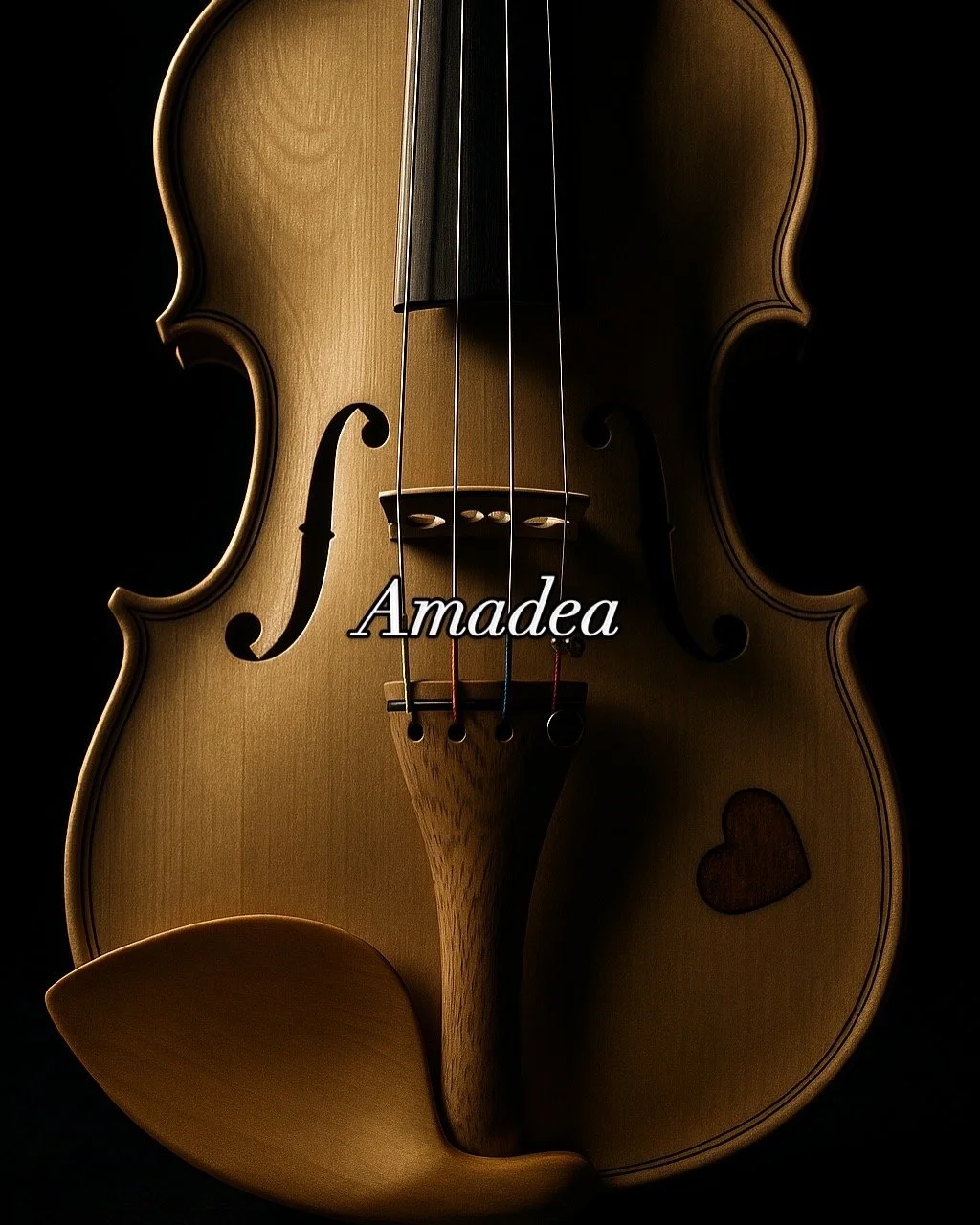
Amadea
A love story in spruce and bloodwood.